During my time at the NRC-CNRC, I explored how to characterise the microstructure of a ceramic sample and understand why certain biological analogues were so much tougher than their synthetic counterparts. This 12-month research exploration, coupled with a fellowship experience at MIT, gave me a deeper insight into bio-inspired structures and how manufacturing technologies are evolving to mimic nature.
The Problem With Brittle Ceramics
Ceramics are a valuable class of materials — heat resistant, wear resistant, chemically inert. But their Achilles heel has always been brittleness. Under stress, cracks propagate almost instantaneously through the material with virtually no energy absorption. For aerospace and structural applications, this is a critical limitation.
Nature, fortunately, has solved this problem millions of years ago. Take Nacre (mother-of-pearl) for example - it's an iridescent inner layer of mollusc shells made of 95% aragonite, an extremely brittle material. Yet nacre is 3,000 times tougher than the same aragonite in bulk. The difference is entirely architectural.
Reverse-Engineering the Microstructure
The natural question (yes, pun intended) isn't just what makes these structures effective. We already know the benefits of composite materials and the role of "hard" and "soft" phases to distribute energy and maintain structural rigidity. It's whether we could systematically identify and reproduce these features in engineered materials. This requires us to develop a way to quantify and reproduce these natural structures.
Convolutional Neural Networks turned out to be a powerful tool for this. I spent roughly six months (January to June 2021) exploring how deep learning could be used to characterise structures in nature. If nature already provides a library of resilient designs, could we extract the underlying engineering parameters directly from them?
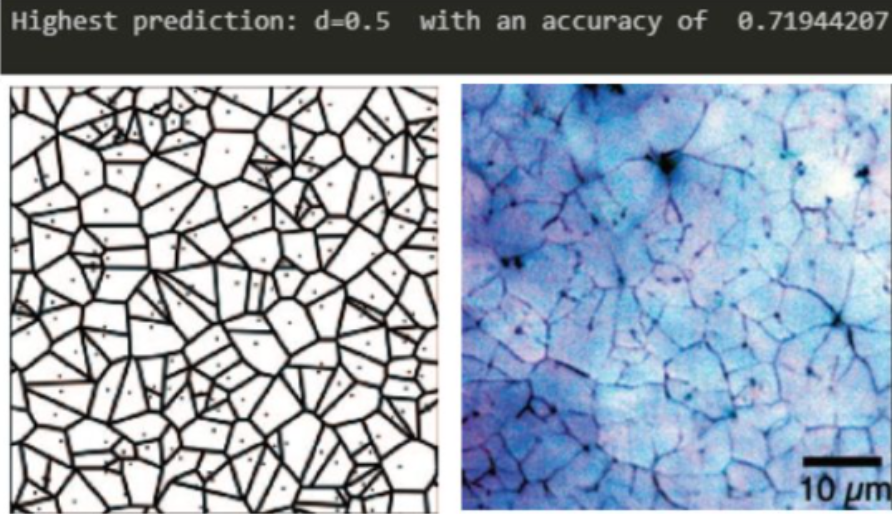
Using OpenCV for image preprocessing and segmentation, and TensorFlow (via Keras in Python) to build and train the model, I developed a CNN that learned to recognise bio-inspired structural patterns and quantify their level of order and disorder.
A perfectly ordered system (like a honeycomb) can be described using a small set of fundamental design parameters. But natural systems often sit somewhere between order and randomness. The model was able to characterise this spectrum across a range of structures, including honeycombs, nacre, and even armadillo shells, with a notable level of accuracy. This enabled us to classify stocastic designs in nature and then use computational methods to reproduce natural structures artificially.
At one point, I even tested it on a tiling pattern I photographed at the Montreal Botanical Garden and it was able to quantify the level of disorder in the layout. A cute test, but a good illustration of how transferable these ideas can be.
Key Insight
After reproducing the natural patterns using a picosecond laser on alumina tiles, I spent a bit more time systematically identifying and cataloguing the architectural features that distinguished high-toughness designs from low-toughness ones. The patterns that emerged were striking:
- Layered "brick-and-mortar" composite architectures that absorb impact energy and deflect crack propagation are key for tough ceramics
- Randomness improved toughness to an extent - perfectly ordered structures allow for easier crack propagation
- Hierarchical structures operating across multiple length scales further improve energy absorption capabilities vs monolithing structures
Individually, none of these features were surprising. But taken together, they pointed to something more important: toughness wasn’t a function of composition alone, but of how structure interacts across multiple scales.
This is where the perspective shifted. The insight wasn’t that these features existed — researchers had known about them for decades. The insight was that they could be produced through deliberate process design.
From Observation to Process
Working backwards from the target microstructure, I mapped process parameters: laser intensity, focal position, material opacity, and power to their resulting structural outcomes. The result was a bio-inspired ceramic manufacturing approach that achieved a 220% increase in toughness compared to conventionally processed samples of the same material. I published a few peer-reviewed journal articles on the subject:
(Publications: Google Scholar Profile)
What Drove Me to Additive Manufacturing
Additive manufacturing makes this idea especially powerful. Unlike conventional processes, it allows engineers to control not just shape, but structure and localized properties. By varying deposition parameters, it becomes possible to program gradients in crystallinity, porosity, and fibre orientation throughout a part. In other words, material behaviour itself becomes a design variable.
Nature doesn’t optimise materials in isolation. Rather, it optimises systems of structure, process, and function simultaneously. As our manufacturing tools become more sophisticated, we’re beginning to approach that same design space. The challenge now is to not only replicate nature’s structures (which we do well today), but to understand the processes that make them possible and to eventually build our own design language from that foundation.